Sofa Price Trends for 2026: Are Prices Going Up or Down This Year?
Introduction
Sofa prices have become an important concern for many home buyers in 2026. Whether you are furnishing a new living room or replacing an old couch, understanding current sofa price trends can help you plan your budget more effectively. Over the past few years, factors such as inflation, shipping costs, and changes in global supply chains have influenced furniture pricing. As a result, many shoppers are asking a simple question: are sofa prices going up or down this year? In this guide, we examine the key trends shaping sofa prices in 2026, what is driving these changes, and what buyers should expect when shopping for a new sofa.
Sofa Price Trends for 2026: Are Prices Going Up or Down This Year?
Sofa prices are rising in 2026, but the increase is expected to be gradual rather than dramatic for most buyers.
One of the biggest drivers is a 25% tariff on imported upholstered furniture, which took effect in October 2025 and is scheduled to remain in place through at least the end of 2026. This policy alone has pushed retail prices higher across many sofa categories.
At the same time, several additional factors continue to influence the average sofa price, including ongoing inflation, elevated shipping costs, and rising raw material expenses such as foam, wood, and fabric.
As a result, the average American household is paying more for a new sofa than at any point in the past decade. However, there is some relief for buyers. Planned tariff increases above 25% have been postponed until 2027, which means price growth in 2026 is likely to remain steady rather than sharply accelerating.
What Is the Average Sofa Price in 2026?
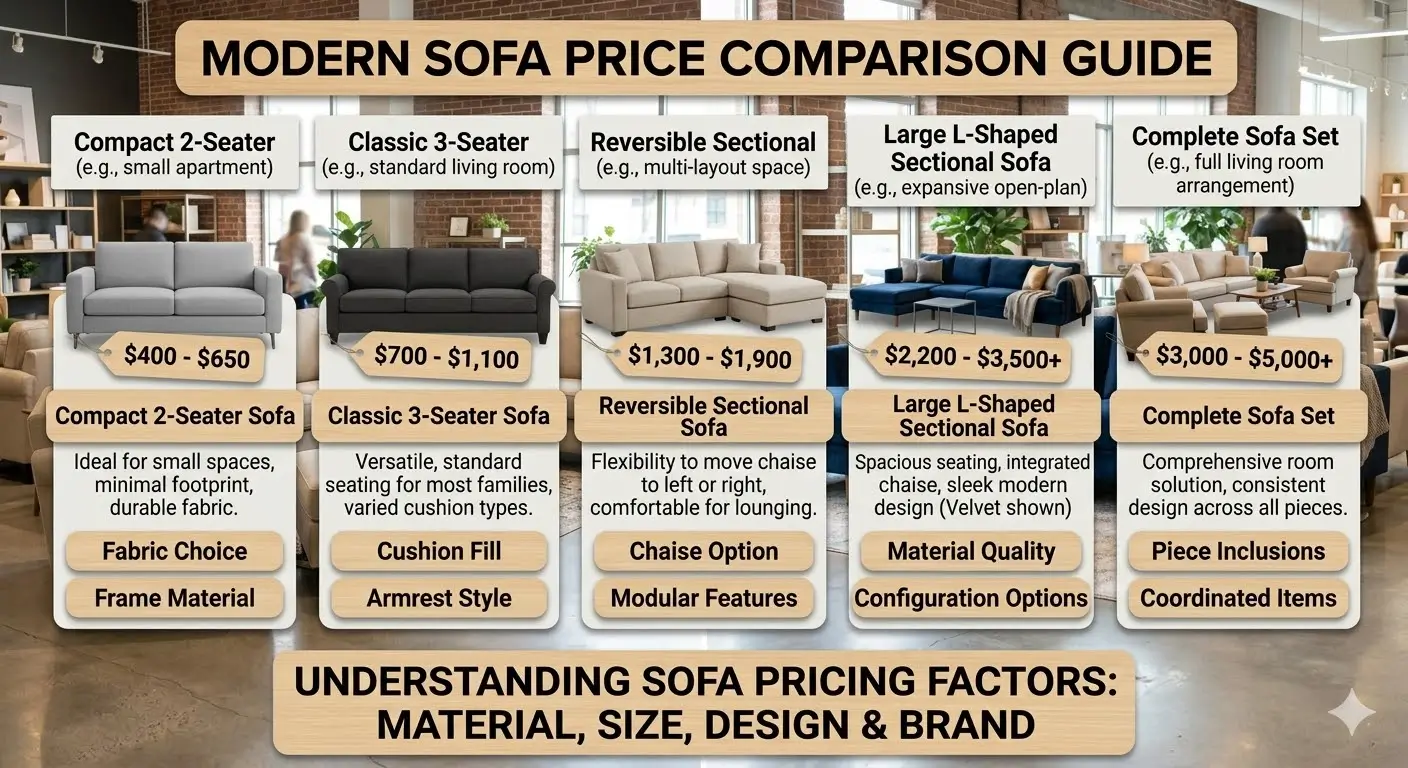
The sofa market spans an enormous price range - from bare-bones budget options to fully custom luxury builds. For most U.S. shoppers buying a quality, everyday sofa in 2026, here's what the market looks like:
| Tier | Price Range | What You Get |
| Budget | $300-$800 | Basic frames, low-density foam, short lifespan |
| Mid-Range | $800-$2,000 | Solid construction, better cushion materials, more style options |
| Upper Mid-Range | $2,000-$3,000 | High-density foam or hybrid cushions, durable upholstery |
| Premium / Luxury | $3,000-$10,000+ | Custom materials, designer brands, heirloom-grade construction |
For a full-size, everyday sofa designed to last, most American households now spend between $1,400 and $1,800 on average. The previous sweet spot of around $1,000 has shifted upward to the $1,300-$1,500 range due to cumulative inflation and import cost pressures.
The practical "buy once" threshold - where you exit low-quality construction entirely - currently sits around $1,800 to $2,200 for most mainstream shoppers.
How Sofa Prices Have Changed from 2023 to 2026
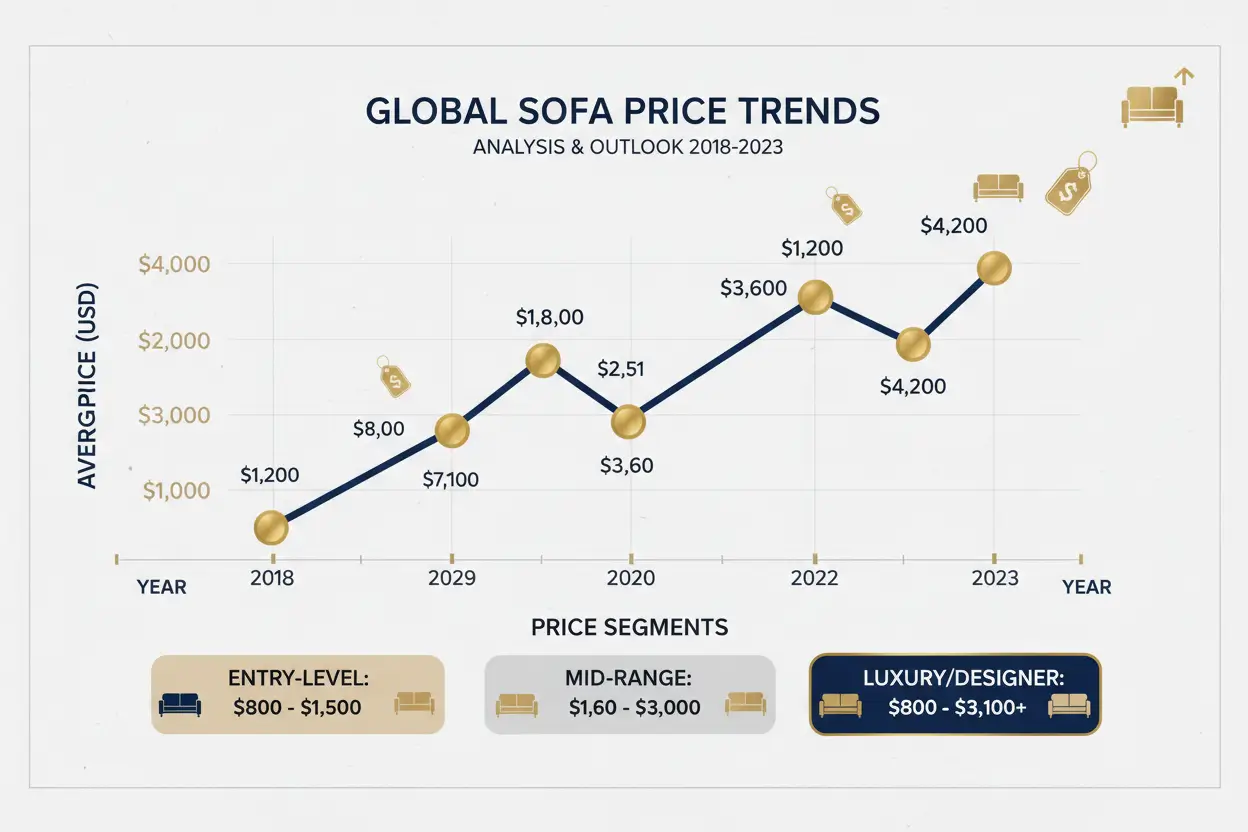
Sofa prices have followed a bumpy path over the past few years, shaped by supply chain shocks, fluctuating demand, and, most recently, new trade policy.
2022: The Peak
Sofa prices peaked in 2022 as post-pandemic demand surged, global shipping costs hit record highs, and raw material shortages drove up the cost of foam, lumber, and upholstery fabric. Many retailers raised prices multiple times within a single year.
2023-2024: A Modest Retreat
Prices pulled back somewhat from their 2022 peaks as supply chains normalized and shipping costs declined. Competition from online and direct-to-consumer furniture brands also put downward pressure on mid-range pricing, giving shoppers more options at lower price points than they'd had in 2022.
2025: Tariffs Arrive
The pricing environment shifted again in late 2025. In October, the U.S. government imposed a 25% tariff on imported upholstered wooden furniture - a category that includes sofas, sectionals, and upholstered chairs with wooden frames. Since most major furniture importers source heavily from China and Vietnam, the cost increases moved quickly through the supply chain and into retail prices. Living room furniture prices were already up 4.6% year-over-year by November 2025, according to inflation data.
2026: Elevated But Stabilized - For Now
The planned escalation of sofa tariffs from 25% to 30% was delayed until at least January 2027, giving retailers and consumers a temporary reprieve from steeper increases. This means sofa prices in 2026 are higher than 2023 and 2024 levels, but the rate of increase is not accelerating sharply - at least until trade policy changes again.
What's Driving Sofa Prices Higher in 2026?
Several forces are working together to push sofa prices upward. Understanding them helps you make a smarter buying decision.
Import Tariffs
The most significant near-term driver. A 25% tariff on imported upholstered furniture - the category that includes most of the sofas sold at mainstream U.S. retailers - has raised the landed cost of every imported sofa. Retailers and brands typically pass most or all of these costs to consumers. While the higher-tier tariff increase was delayed to 2027, the current 25% duty is already baked into today's retail prices.
Raw Material Costs
The materials inside a sofa - high-density foam, solid wood frames, fabric upholstery, metal hardware - have all remained more expensive than pre-2020 levels. Domestic manufacturers are not immune to this pressure, as foam, lumber, and metal inputs are all subject to their own price dynamics and import costs.
Shipping and Logistics
While ocean freight costs have come down significantly from their 2022 peak, they remain elevated compared to pre-pandemic rates. Importers continue to price in higher logistics costs than shoppers were accustomed to before 2020.
Labor and Manufacturing
Labor costs at furniture manufacturing hubs in Asia have risen over the past several years, compressing the cost advantage that made imported furniture so competitively priced. This is a slower-moving factor but a persistent one.
Inflation Carry-Over
Overall U.S. inflation has risen roughly 26% since early 2020. Furniture, interestingly, has grown in price at a slower rate than general inflation - which means furniture hasn't been as aggressive a culprit in the cost-of-living squeeze as groceries or housing. But the cumulative effect is still real: a sofa that cost $1,000 several years ago now carries a price tag closer to $1,300 to $1,500 for the same quality.
Budget vs. Mid-Range vs. Premium: Where Has the Price Gap Changed Most?
Budget Sofas ($300-$800)
Budget sofas have stayed available at entry-level prices because of intense market competition and big-box retailers' ability to source from lower-cost overseas manufacturers. However, tariffs are beginning to squeeze this tier. Expect fewer options under $600 that aren't made with significantly compromised materials or construction.
Mid-Range Sofas ($800-$2,000)
This is where the impact of tariffs and inflation is most visible. Sofas that reliably sold for $1,000 to $1,200 in 2023 now frequently carry prices of $1,300 to $1,600 for comparable quality. This tier remains the most competitive and is where the best overall value is typically found.
Premium Sofas ($2,500 and above)
High-end sofas have seen the smallest percentage impact from tariffs because their prices are driven more by brand, design, and materials than by import cost dynamics. Custom and domestically produced premium sofas are largely unaffected by the current tariff structure. At this tier, price growth has been more closely tied to material and labor costs than trade policy.
How Online Furniture Brands Are Affecting Sofa Pricing
The growth of direct-to-consumer (DTC) furniture brands - selling primarily online without traditional showroom overhead - continues to be one of the most significant competitive forces holding sofa prices down in the mid-range segment.
Online-only furniture retailers typically price sofas between $1,200 and $2,200, compared to $1,500 to $3,000 for traditional brick-and-mortar stores carrying comparable quality. The savings come from reduced overhead: no showroom rent, fewer sales staff, and streamlined fulfillment.
However, DTC brands are not immune to tariff pressures since most still import from overseas. The difference is that their lower operating cost structure gives them more room to absorb or offset tariff-related price increases without raising retail prices as sharply as traditional retailers.
For budget-conscious shoppers, online brands continue to offer some of the best price-to-quality ratios available - provided you understand the trade-off of not being able to test the sofa before purchasing.
Will Sofa Prices Rise or Stabilize for the Rest of 2026?
The most likely scenario for the remainder of 2026 is gradual upward drift rather than a sharp spike. Here's why:
- The 25% tariff is already priced into current retail tags, so there's no imminent step-up from that factor alone
- The larger tariff increase (to 30%) is delayed until 2027, removing a near-term pressure point
- Ongoing trade negotiations between the U.S. and major furniture-exporting countries create some possibility of tariff adjustments - in either direction
- Competition between online and traditional retailers continues to limit how aggressively any single seller can raise prices
The risk of faster price increases comes if trade negotiations break down, if tariffs are expanded to additional furniture categories, or if raw material costs spike again. Shoppers planning to buy a sofa later in 2026 are unlikely to see dramatically different prices from today - but waiting for prices to fall meaningfully is not a well-supported strategy.
Tips for Buying a Sofa at the Best Price in 2026
Buy before potential tariff changes. Trade policy in 2026 remains dynamic. If tariff rates increase, prices will follow. Shopping earlier in the year rather than waiting gives you access to current pricing before any new policy changes take effect.
Target the major sale windows. Furniture retailers consistently offer their deepest discounts during Memorial Day, Labor Day, and Black Friday. These periods can deliver 20% to 40% off regular pricing - a meaningful saving on a $1,500 to $2,500 purchase.
Compare online vs. in-store pricing. For comparable quality levels, online DTC brands regularly undercut traditional retailer pricing by $200 to $600. Use in-store visits to identify styles and sit tests you like, then compare equivalent options online.
Check the country of origin. Sofas manufactured in the United States are not subject to import tariffs, which can make domestically produced options more price-competitive than they were several years ago. If a retailer highlights U.S.-made construction, it's worth comparing the final price to imported alternatives at the same quality level.
Don't ignore delivery and assembly costs. Budget an additional $100 to $250 for delivery depending on your location and retailer. In urban markets like New York and Los Angeles, buyers typically pay 10 to 15% more than the Midwest for the same sofa, driven largely by logistics and warehousing costs.
Look for open-box or floor model deals. Many retailers - both online and in-store - offer floor models, customer returns, or open-box inventory at 20 to 40% below original retail. These are often in excellent condition and come with the same warranty coverage.
Conclusion
Sofa prices in 2026 are trending upward - driven by import tariffs, persistent material cost increases, and lingering inflation - but the rate of increase is moderate rather than severe. The average quality sofa now costs $1,400 to $1,800 for most U.S. households, with the best-value window sitting between $1,800 and $2,200 for a sofa built to last. Shoppers who plan purchases around major sale events and compare online vs. retail pricing can still find strong value this year. If you're looking for a brand that delivers well-designed sofas with solid value for the price, Atunus Home is worth exploring. Known for combining quality construction with approachable pricing, Atunus Home offers sofa collections that hold their own in both comfort and durability - making them a smart choice for shoppers navigating a more expensive furniture market in 2026.